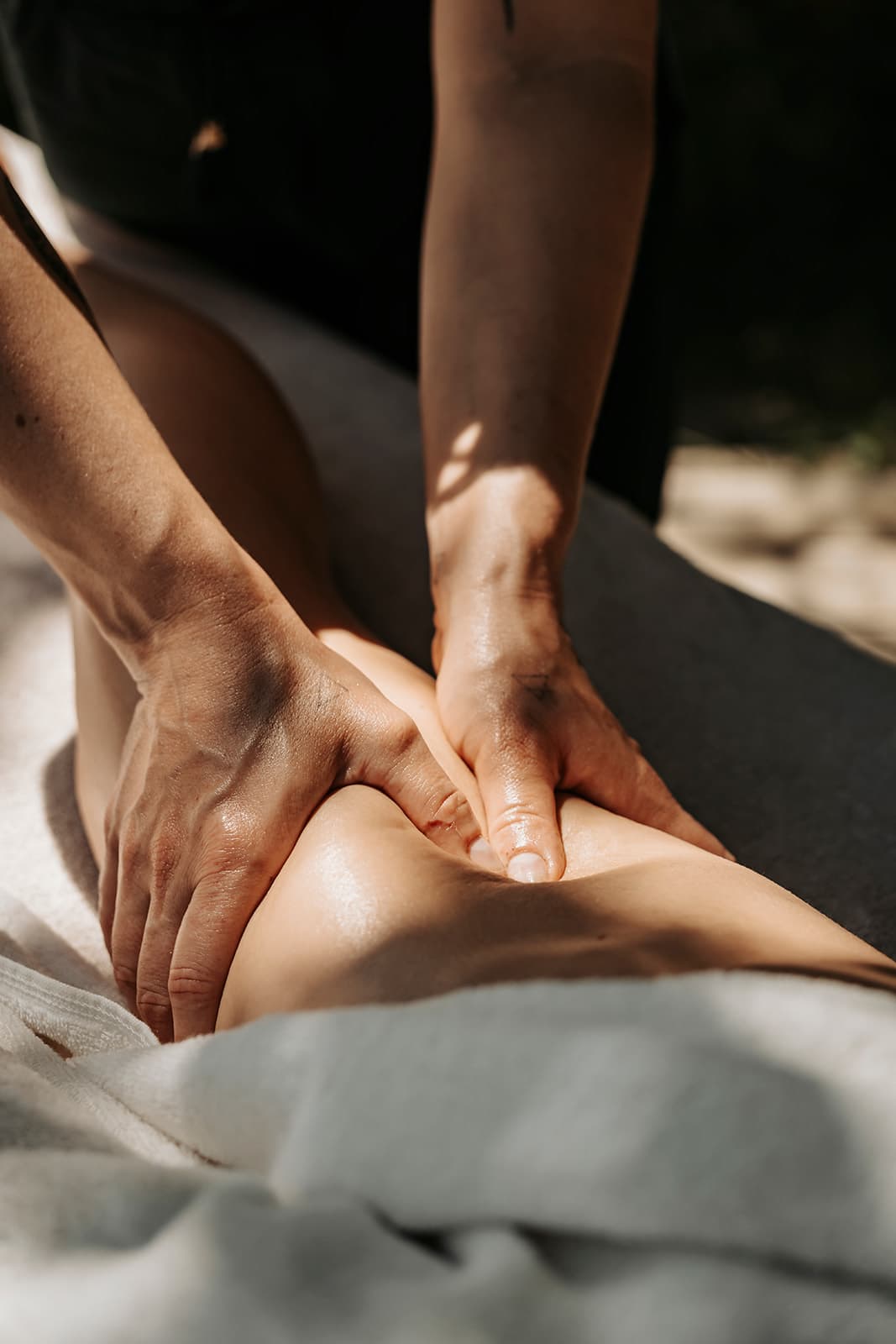
Recovery after surfing, as after any sport, rests first on four simple pillars: drinking and eating within the hour after the effort, sleeping enough, moving lightly the next day rather than staying still, and keeping your mobility without forcing it. Recovery massage comes on top of that, when tension builds session after session and the body can no longer do the work on its own. Here is how I set it out for the surfers I see in Hossegor.
What surfing asks of the body
In Hossegor everyone knows the morning after a big session: heavy shoulders, stiff neck, a lower back that pulls. Surfing is an asymmetric, intermittent sport: long minutes of paddling with the shoulders rotating and the back extended, then a few seconds of explosive effort at take-off, loading the legs and trunk. The areas that take the most are the shoulders and rotator cuff, the neck, the lower back (held in extension while paddling) and the hips. Golf, trail running and cycling have their own areas, but the logic of recovery is the same.
A surf trip compresses all of this. Five or six days in a row of two-hour sessions is a training load most people never take on at home, on top of travel, a different bed and later nights. That is why the fourth day is so often the hard one.
The four fundamentals
1. Drink and eat within the hour
Two hours in the water dehydrates you more than you think, even when you are not hot. Water as soon as you come out, then a real meal with carbohydrates and protein within the hour: muscle repairs with what you give it. No supplements needed for recreational surfing.
2. Sleep
Deep recovery happens at night. Public health guidance puts adult sleep at seven to nine hours; after a big day, most people are below that. Nothing replaces a real night’s sleep, not stretching, not massage.
3. Move lightly the next day
Complete stillness does not help: it sets. A walk, an easy bike ride, a calm swim, twenty to thirty minutes at low intensity, is enough to get the circulation going and make soreness more bearable. This is what is called active recovery.
4. Stretching after sport: without forcing, never cold
According to the available literature, stretching has not been shown to prevent soreness. Practised regularly, in the evening, on a warm body, it can however help preserve the shoulder and hip mobility that surfing tends to close down. A few minutes, without chasing performance.
Recovery massage: what it brings, and what it does not
A review published in 2018 in Frontiers in Physiology compared the most common recovery techniques (massage, compression, cold water immersion, stretching, active recovery). Massage came out as one of the most effective for reducing soreness and perceived fatigue. The authors stay cautious about the mechanisms, and so do I: recovery massage does not heal an injury and does not magically speed up muscle repair. What many athletes feel is a less heavy body, localised tension letting go, and easier sleep the following night.
Three techniques I combine
- trigger point massage, targeted pressure on stubborn muscle knots (shoulders, glutes, calves);
- fascia therapy, slow pressures to give tissue its glide back, useful when the stiffness is diffuse. I cover it in fascia therapy: what it does;
- assisted stretching, guided stretches on the table to reopen hip and shoulder range.
All of it is set out on the sports & recovery massage page, along with Deep Stretch & Massage, the two-hour treatment that combines trigger points and stretching.
When to schedule a massage in the week
- After a big session or a training block: the same day or the next, something gentle to medium, to release;
- As maintenance: every two to four weeks, deeper work (trigger points, fascia, stretching);
- Before a competition: no deep work in the 48 hours beforehand; a light, stimulating massage the day before, possibly;
- With acute pain, an injury or a suspected sprain: no massage, see a doctor or a physiotherapist. My treatments are wellness massages, not therapeutic ones.
On a week-long trip, the sweet spot is usually the evening of day three or four: late enough for the load to have built, early enough to still get something out of the sessions that remain.
The signals that say the body is not keeping up
Tension that comes back to the same place despite rest, a stiff neck or lower back on waking several days running, a paddling stroke losing range, less restorative sleep: these are the signs that passive recovery is no longer enough. That is when an outside hand makes the most sense.
After a session the simplest option is often a massage where you are staying: I bring the table, you do not have to get back in the car. I travel to Hossegor, Seignosse, Capbreton and within 15 km, to houses, rentals, hotels, campsites and surf camps. The Maison Rita studio in Hossegor is open the rest of the time, and everything happens in English if you prefer.
Surf recovery: frequently asked questions
Should I get a massage straight after surfing or the next day?
Both work. Straight after, a gentle to medium massage helps you release while the body is still warm. The next day, we work more precisely on the areas that have stiffened. Just avoid very deep work in the hours following a maximal effort.
Does massage prevent muscle soreness?
It does not prevent it, but the available literature ranks it among the techniques that can help reduce its intensity and the feeling of fatigue. The fundamentals remain hydration, a meal after the effort, sleep and active recovery.
Which massage should I choose for surf recovery?
For localised tension (shoulders, neck, glutes), trigger point massage. For diffuse stiffness, fascia therapy. To regain range, assisted stretching. Deep Stretch & Massage combines trigger points and stretching in two hours; it is the treatment I most often recommend to surfers.
Can I be massaged with an injury?
No. With acute pain, a sprain, a tear or a suspected injury, see a doctor or a physiotherapist first. My massages are wellness treatments and do not replace medical care.
Can a whole surf camp group book?
Yes. I do consecutive sessions on site, one after another, at the camp or the house. Tell me the number of people and the window you have, and I will tell you honestly what fits.
How soon after arriving should I book?
In summer the diary fills several days ahead, so message me when you book your trip rather than the morning you want it. Out of season, the same day is often possible.
Sources
- Dupuy O. et al., “An evidence-based approach for choosing post-exercise recovery techniques to reduce markers of muscle damage, soreness, fatigue, and inflammation: a systematic review with meta-analysis”, Frontiers in Physiology, 2018.
- Herbert R.D., de Noronha M., Kamper S.J., “Stretching to prevent or reduce muscle soreness after exercise”, Cochrane Database of Systematic Reviews, 2011.
- Anses, opinion and report “Actualisation des repères du PNNS: physical activity and sedentary behaviour”, 2016.