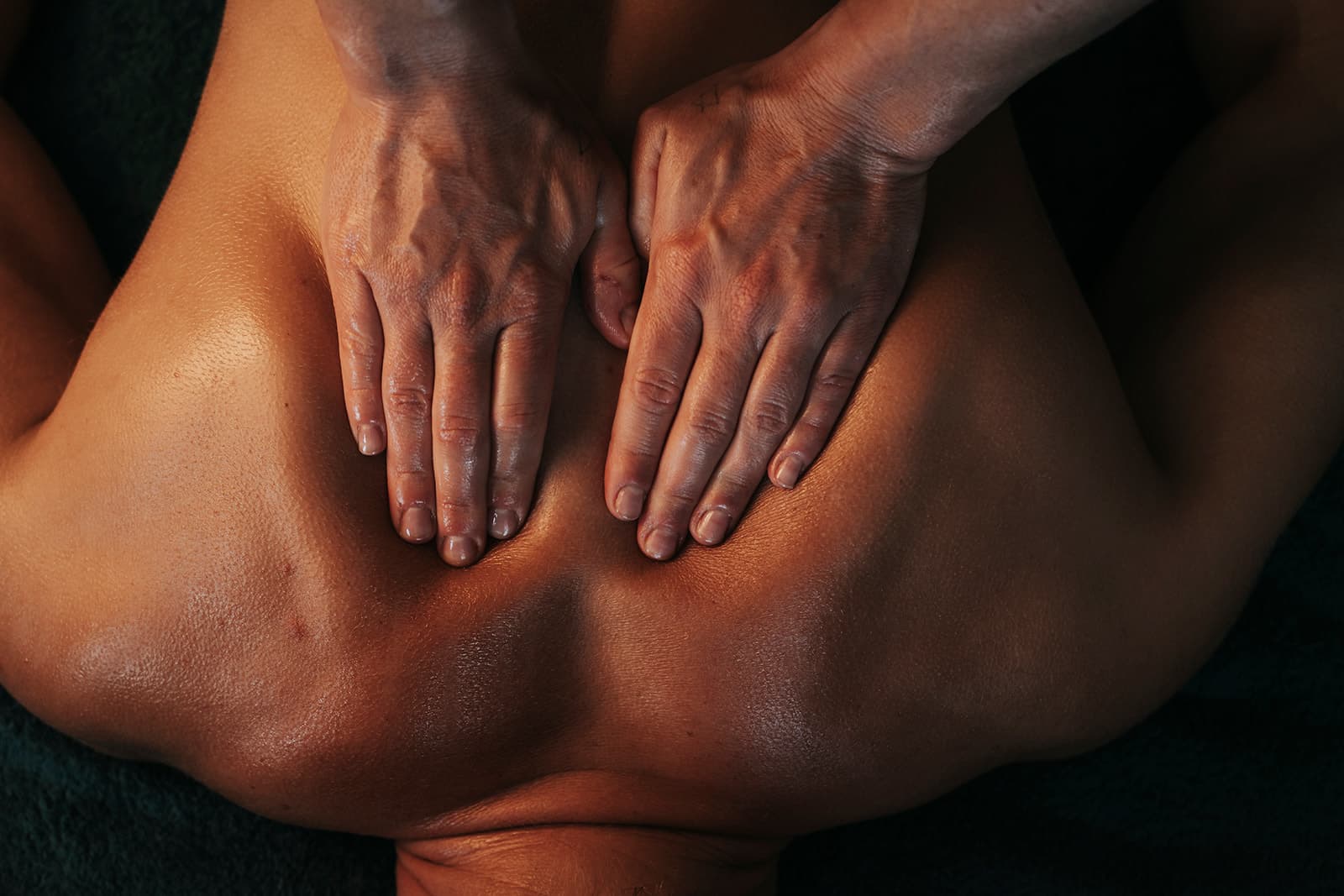
Fascia therapy is a manual technique that works on the fascia, the connective tissue membranes that wrap and connect muscles, bones and organs. Through slow, deep pressures, it aims to give glide back to tissue that has become stiff, so the body finds ease in movement again. At the studio I work with the Tissual Balancing® method, in 1h15 sessions, as a wellness treatment and not a therapeutic one.
What is fascia?
Picture a continuous web, thin and strong, that starts at the skin, surrounds every muscle, every muscle fibre and every organ, and runs all the way to the bone. That is fascia. It was long treated as simple packaging; anatomical research now credits it with a far more active role: transmitting force from one segment to another, sensing the body in space, hydrating and letting layers glide over one another.
Supple and hydrated, fascia goes along with every movement without your thinking about it. Stiffened by stress, by sitting still, by an old injury or by training repeatedly along the same axes, it loses part of that glide. Layers stick, movement shortens, and diffuse tension settles in, sometimes a long way from where it started. Many people describe this as a body that will not let go, even at rest.
What a fascia therapy session works on
Slow pressures, not kneading
Fascia therapy is neither a classic relaxing massage nor a joint manipulation. The touch is slow, firm, precise, and above all it waits: I place a pressure on an area, let the tissue answer, and follow that release to the end before moving on. The session uses little or no oil, often on the back, hips, thighs, shoulders and neck, depending on what I feel under my hands and what you describe to me.
What it feels like, during and after
The pressure is deep but it must never be painful: you stay in control of the intensity, and I encourage you to say so. During the session many people feel local warmth, then a sense of unfolding. Afterwards, the most common feedback is of a longer body, a fuller breath, a movement that reaches a little further. Mild tenderness the next day is possible, as after gentle exercise.
The Tissual Balancing® method
This is the method I trained in. It organises fascia work in chains, from head to foot, rather than area by area: stiffness in the lower back is sometimes worked starting from the hips or the back of the thighs. That is why I may not spend long on the exact spot that worries you.
The benefits people report
I prefer to talk about benefits people report rather than guaranteed effects. What my clients describe most often:
- mobility recovered in a stiff area (neck, shoulders, hips, ankles);
- release of tension that keeps coming back to the same place;
- a feeling of lightness and deep calm, different from an oil massage;
- among athletes, more comfortable recovery between training sessions.
According to the available literature, manual techniques that mobilise soft tissue may help improve range of motion and short-term comfort; the precise mechanisms are still debated and the studies are small. So I stay measured: fascia therapy cures nothing, it can help the body find ease again.
Who is fascia therapy useful for?
- Stiff or set bodies, often after years of desk work, driving or repetitive movement;
- Athletes (surfing, golf, trail running, cycling) whose tension builds up session after session. I happily combine it with sports and recovery massage;
- People under stress, whose bodies stay tense even at rest;
- People over 50 who want to keep their freedom of movement, without forcing anything.
It is not a treatment reserved for athletes. If stiffness gets in the way day to day, the piece on everyday mobility is a good companion to this one.
Side effects, precautions and contraindications
Side effects of fascia therapy are generally mild and short-lived: tenderness in the areas worked for a day or two, a pleasant tiredness that evening, sometimes marked thirst. They pass on their own; water and gentle movement the next day are enough. If discomfort lasted beyond a few days, speak to your doctor.
Like any wellness massage, fascia therapy is not appropriate in cases of fever, infection, phlebitis or a known circulatory disorder, acute inflammation, recent fracture or an open wound on the area. If you have an ongoing condition, take anticoagulants, are pregnant or are in any doubt, speak to your doctor, then to me before the session: I adapt or I refer you. I make no diagnosis and my sessions do not replace medical follow-up or physiotherapy.
Price and practical details, at the studio or where you are staying
The session lasts 1h15 and costs €80, the same price at your accommodation within the included radius. I give it at the Maison Rita studio in Hossegor and wherever you are staying within 15 km (Capbreton, Seignosse, Soustons, Labenne and around). Come in comfortable clothes; we always start with time to talk about how you feel. All treatments and prices are on the services & prices page.
Fascia therapy: frequently asked questions
Is fascia therapy painful?
No. The pressure is deep and slow, but it always stays below the pain threshold. You remain in control of the intensity and I encourage you to speak up at any point. Mild tenderness the next day is possible, as after gentle exercise.
How many sessions do I need?
Many people feel a difference from the first session. For stiffness that has been there a long time, two to three sessions two to four weeks apart often stabilise the release. After that, an occasional maintenance session is enough, based on how you feel.
What is the difference between fascia therapy and a classic massage?
A classic massage works mainly on muscle, with oil and flowing movements. Fascia therapy works on connective tissue, with little or no oil, through slow held pressures that wait for the tissue to answer. The sensation is deeper and the effect on mobility clearer.
What are the side effects of fascia therapy?
They are mild and short-lived: tenderness in the areas worked for a day or two, a pleasant tiredness that evening, sometimes marked thirst. Water and gentle movement the next day are enough. If discomfort persists, speak to your doctor.
Is fascia therapy covered by insurance?
Not by the French health system. It is a wellness massage, not a therapeutic one, practised outside the medical framework. Some private health policies include a wellbeing allowance: it is worth asking yours. I can provide a receipt.
Sources
- Schleip R., Findley T., Chaitow L., Huijing P. (eds.), Fascia: The Tensional Network of the Human Body, Elsevier, 2012.
- Wilke J. et al., “What is evidence-based about myofascial chains: a systematic review”, Archives of Physical Medicine and Rehabilitation, 2016.
- Inserm, “Douleur” dossier (inserm.fr): non-drug approaches and the limits of the available evidence.