Mobility is the freedom of movement in your joints: being able to squat, to look behind you, to reach something above your head without compensating. You lose it by not using it, and you get it back the same way: by using it, a little, every day. You do not need to be an athlete. Here is how I explain it to the people I see, sporty or not.
Mobility and flexibility are not the same thing
Flexibility is a muscle’s ability to lengthen: touching your toes with straight legs, for instance. Mobility is a joint’s ability to travel its whole range under control, with the muscles around it. You can be flexible and not very mobile (a hip that goes a long way when pushed, but that you cannot take there yourself), and the reverse. Day to day, mobility is what counts: it decides the quality of your movement, from walking to gardening, from surfing to simply getting up off the floor.
Why it goes
The body closes the doors you stop opening
Hours sitting, hips and knees bent at ninety degrees; shoulders that no longer go overhead; a spine that rarely rotates beyond what the rear-view mirror demands. The body is thrifty: a range you do not use, it stops maintaining. Muscles shorten, fascia loses its glide, the joint capsule stiffens. French public health data puts adults at more than seven hours a day seated on average, and sedentary time is identified as a risk factor in its own right, independently of whatever exercise you do elsewhere.
Repeated movement
Sport is no protection. A surfer paddling for hours, a golfer always turning the same way, a runner who only runs: each develops enormous range along one axis and loses it along the others. The loss is then asymmetric, and that is often where tension settles.
Age, a little, but less than people think
Tissue naturally loses elasticity over the years. But most of what gets blamed on age comes down to use: the seventy-year-olds who still squat are the ones who never stopped.
Everyday mobility exercises: keeping it simple
Public health guidance converges: move regularly, break up sitting time, and add flexibility and balance work to endurance activity. In practice, what I advise, and it takes a few minutes a day:
- Vary your positions through the day: sit on the floor in front of the television, squat to pick things up, stretch when you get up from your chair every hour;
- Walk every day, even twenty minutes: walking mobilises hips, pelvis and spine in a cross-body movement nothing else replaces;
- Five minutes of joint mobility in the morning: shoulder circles, hip rotations, slow spinal flexion and rotation, ankle circles. A small daily routine beats a big rare session;
- Breathe: a ribcage that expands means a back and shoulders that move better. A few full breaths with your hands on your ribs are enough to feel it;
- Do not force: mobility is won through comfort and repetition, not through pain.
The three areas to watch
- The hips: the first to close up with sitting. Simple test: can you squat with your heels down, and stand back up without your hands?
- The thoracic spine: the part of the back between the shoulder blades, which rounds in front of a screen. When it stops rotating, the neck and lower back compensate;
- The ankles: often forgotten, they govern squatting, walking on uneven ground and, for surfers, your stance on the board.
When to get help
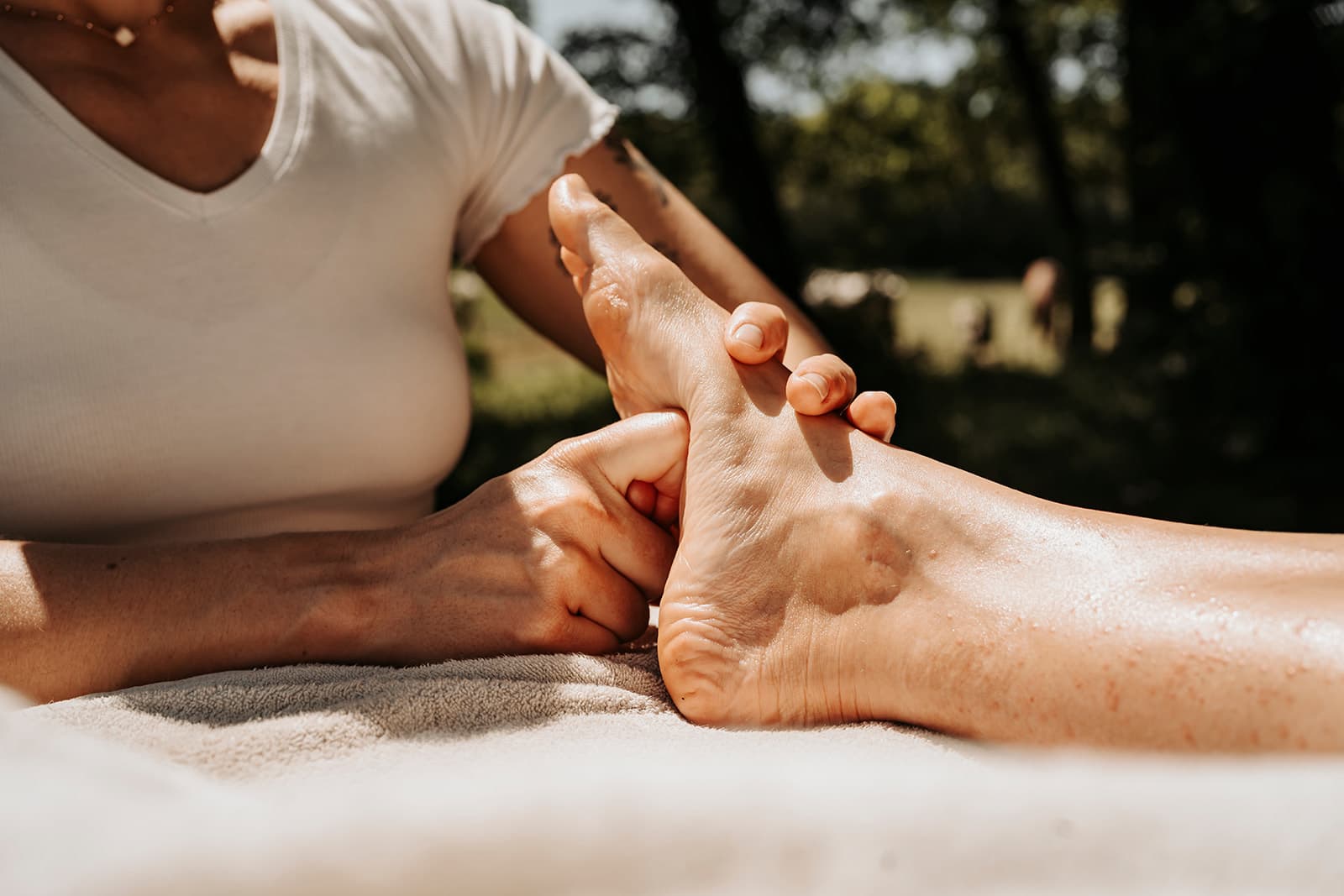
When stiffness has been settled in for months, exercises alone often hit a ceiling: the body protects itself, and you cannot relax enough to go further. That is where an outside hand makes sense. Two of the studio’s techniques suit this particularly well:
- fascia therapy, slow pressures that can help give stiffened tissue its glide back;
- assisted stretching, guided stretches on the table that reopen range without your having to hold anything. I explain the principle in assisted stretching, explained.
These are wellness massages, not therapeutic ones, suitable at any age, athlete or not. They do not replace medical advice: with persistent joint pain, a sudden loss of mobility or a history of joint replacement, speak to your doctor or physiotherapist first. The techniques are set out on the services & prices page; for athletes, the sports & recovery massage page describes Deep Stretch & Massage. I work from the Hossegor studio and travel to where you are along the southern Landes coast.
Everyday mobility: frequently asked questions
How long a day does it take to maintain mobility?
Five to ten minutes is enough if it is daily: a few shoulder, hip and ankle circles, slow spinal rotations, morning or evening. Consistency counts far more than duration.
Can you regain mobility after 50?
Yes. Tissue loses a little elasticity with age, but most stiffness comes down to use. Many people over 50 recover a comfortable range with gentle, regular practice, helped where useful by fascia therapy or assisted stretching.
Mobility or stretching: which comes first?
Mobility, meaning controlled movement through the joint's full range. Passive stretching complements it, preferably in the evening on a warm body. If you kept only one thing, keep the daily walk and five minutes of mobility in the morning.
When should I see a professional rather than book a massage?
As soon as there is persistent joint pain, a sudden loss of mobility, swelling, or recent surgery or a joint replacement. A doctor or physiotherapist should see that first. My treatments are wellness massages, not medical care.
Sources
- Anses, “Actualisation des repères du PNNS: physical activity and sedentary behaviour”, collective expert opinion and report, 2016.
- Haute Autorité de santé, guide to the promotion, consultation and medical prescription of physical activity for health in adults, 2019 (updated 2022).
- Inserm, collective expert review “Physical activity: prevention and treatment of chronic disease”, 2019.