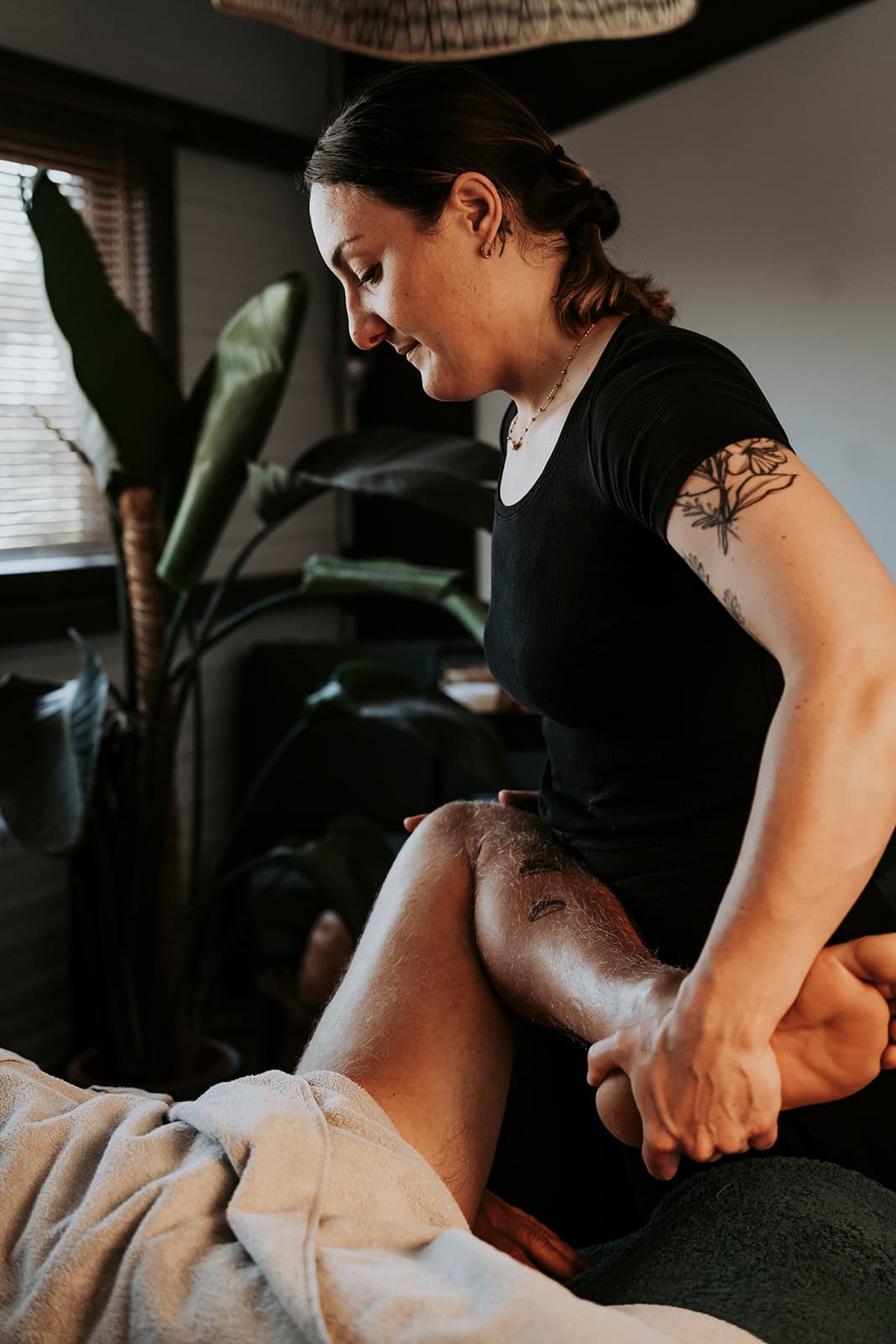
Assisted stretching is a session of stretches in which you do nothing: lying on a table, relaxed, you are stretched by a practitioner who places, holds and releases each position for you. Because the body does not have to hold itself up, it accepts going further than it would on its own, without forcing. At the studio I work with the Be.Stretch® method, in 1h15 sessions, as a wellness treatment.
Why you hit a ceiling stretching alone
When you stretch, you are asking one muscle to lengthen while other muscles hold your posture. As soon as the stretch gets serious, a protective reflex fires: the muscle contracts slightly to defend itself against what it reads as a risk. That is useful, but it caps the range. Add the difficulty of relaxing in a position you are holding yourself, and the fact that we almost always stretch the same areas, the ones we know how to reach.
On the table, those three limits fall away: you have nothing to hold, you breathe, and I can work whole chains, including the ones nobody stretches alone (hip rotators, psoas, the lateral chain, deep shoulder).
What a Be.Stretch® session involves
How it runs
We start with a conversation: your activity, your stiff areas, your history. You stay dressed, in loose clothing. I then work segment by segment, generally from feet to head: calves and posterior chain, hips and glutes, pelvis and lower back, ribcage, shoulders and neck. Each stretch is placed slowly, held across several breaths, then released. I often ask for a light contraction followed by a release, the technique known as contract-relax: that is what allows range to open up gently.
What you feel
A clear but comfortable stretch, never pain: I set the range by your breathing and by what you tell me. At the end of the session the range you have gained is immediately noticeable as you get off the table: you stand taller, the hips are freer, the neck turns further. The next day a worked-muscle feeling is possible, without significant soreness.
What you can expect from it
According to the available literature, regular stretching, and assisted contract-relax techniques in particular, may help increase joint range, and the sense of suppleness settles in when the practice is repeated. Stretching alone, on the other hand, has not been shown to reduce muscle soreness after exercise. So I stay careful about promises. What my clients describe most often:
- greater range of motion in the hips, hamstrings and shoulders;
- a sense of a longer body, of a more open posture;
- mental release, because you breathe and you do nothing;
- among athletes, freer movement on the next outing and more comfortable recovery.
Who is it for?
- Athletes: surfers with stiff shoulders and lower backs, golfers looking for rotation, runners and cyclists with short posterior chains;
- People who sit all day and feel their hips closing up;
- Naturally stiff bodies, who have never enjoyed stretching alone, precisely because it was uncomfortable;
- People over 50 who want to keep their freedom of movement without hurting themselves.
If you surf, the piece on recovery after surfing explains where assisted stretching sits in a training week.
Precautions
Assisted stretching is gentle but it loads the joints: I do not practise it on a recent injury (sprain, tear, fracture), a recent joint replacement, an acute disc herniation, acute inflammation, or during pregnancy without medical advice. If you are under treatment or in rehabilitation, speak to your doctor or physiotherapist; my sessions are a wellness treatment and are not a substitute.
On its own, or combined: Deep Stretch & Massage
Assisted stretching exists as a standalone session (1h15, €120). It is also the backbone of Deep Stretch & Massage, the studio’s signature treatment (2h, €190), which adds trigger point work to release the most stubborn areas before stretching them. The whole thing is built for athletes and stiff bodies, and it is set out on the sports & recovery massage page. Both are available at the Hossegor studio and where you are staying, where I bring the table. The other treatments and prices are on the services page.
Assisted stretching: frequently asked questions
Do I need to be flexible for assisted stretching?
No, quite the opposite. Stiff people are the ones who report the most benefit: since you have nothing to hold, I can stretch areas you cannot reach alone. Every range is set to your body on the day.
What should I wear?
You stay dressed. Bring loose, comfortable clothing, leggings or sports shorts and a t-shirt, that does not restrict hip and shoulder movement.
How often should I do it?
To build a lasting gain in range, one session every two to three weeks at first, then once a month to maintain it. Between sessions, a few minutes of mobility work at home extends the effect.
Assisted stretching or sports massage: which should I choose?
If what you want above all is range and freedom of movement, assisted stretching. If the tension is localised and tender to the touch, trigger point massage. Deep Stretch & Massage combines both in a two-hour session.
Is this the same as Thai massage?
It shares the idea of assisted stretching on a table with you dressed, and people often use the phrase Thai stretching to describe it. The Be.Stretch® method is a modern, Western protocol, worked segment by segment with contract-relax, without the traditional Thai framework.
Sources
- Page P., “Current concepts in muscle stretching for exercise and rehabilitation”, International Journal of Sports Physical Therapy, 2012.
- Behm D.G. et al., “Acute effects of muscle stretching on physical performance, range of motion, and injury incidence in healthy active individuals: a systematic review”, Applied Physiology, Nutrition, and Metabolism, 2016.
- Herbert R.D., de Noronha M., Kamper S.J., “Stretching to prevent or reduce muscle soreness after exercise”, Cochrane Database of Systematic Reviews, 2011.