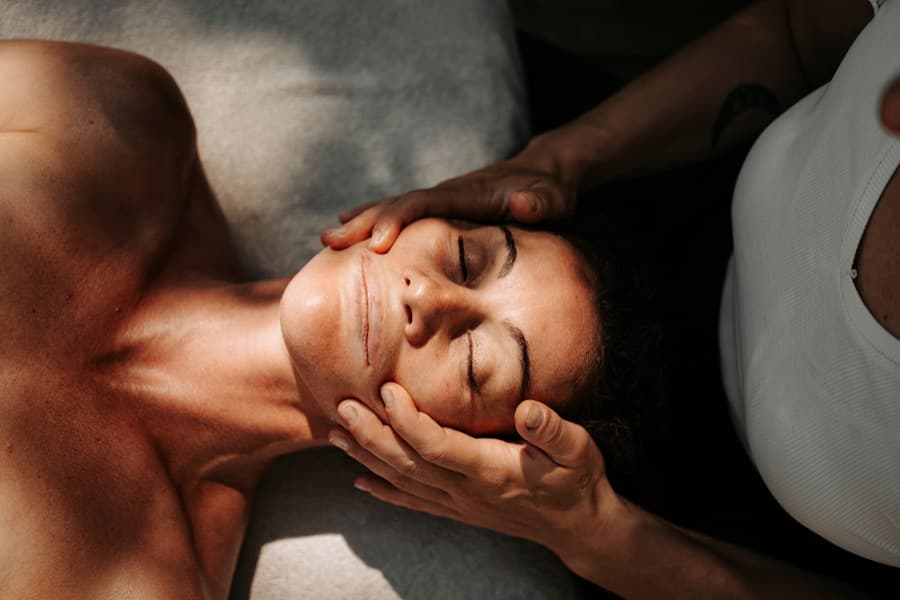
Kobido is a facial massage of Japanese origin, entirely manual: no device, no needle, nothing injected. It combines held pressures on precise points, deep slow strokes, and a series of very fast fingertip percussions, across the face, neck and décolleté. I give it at the studio as a 1h15 session, as a wellness treatment and not a therapeutic one.
Where kobido comes from
The word means roughly « ancient way of beauty ». Japanese tradition traces the practice to the fifteenth century, in a context of treatments reserved for a very small circle, then passed from master to student. That history is worth taking for what it is: an account of transmission, not a verifiable fact. What is verifiable is the technique itself, which has changed little: long, rhythmic manual work alternating very slow passages with very fast ones.
What a session involves
Before: ten minutes of conversation
We always start by talking: how you feel, your skin, your sleep, tension in the jaw or forehead, any current treatment, any recent cosmetic procedure. Those ten minutes determine the intensity I use and the areas I will avoid. Make-up comes off before the treatment; I work with an oil or balm suited to your skin.
During: three textures of touch
The treatment alternates three families of movement. Held pressures on points of the face, skull and neck, releasing areas we clench without noticing, starting with the jaw. Deep, slow strokes from the centre of the face towards the temples and the neck, which give the treatment its stretched, released quality. And very fast fingertip percussions, the signature of kobido: it is noisy, a little surprising the first time, and never painful. Neck and décolleté are included; so is the scalp, often, because it holds a good share of the tension in the forehead.
After: time to get up slowly
The face is warm, sometimes flushed for an hour or two, the skin softer to the touch. Most people describe above all a released jaw and a level of calm close to that of a full body massage. I leave you time to get up unhurried; do not schedule anything important in the half hour that follows.
What to expect from it, and what not to
A lot of before and after photographs circulate around kobido. I would rather be clear: a facial massage does not change the structure of your face, replaces no cosmetic medical procedure, and does not erase an established line. What you see after a session is a face that is relaxed, better perfused, less clenched, and that does show, particularly on the features that tension was hardening. The effect is real, and it is temporary: it holds for a few days.
What the people I see report most often:
- a released jaw, especially among those who clench at night;
- a brighter complexion in the hours that follow;
- general calm, sometimes drowsiness during the treatment;
- skin that takes their usual products better over the following days.
The available research on facial massage rests on small samples and mainly measures effects on tension and mood. It is honest to stop there: kobido is a pleasant, repeatable wellness treatment, not a therapy.
Contraindications and precautions
Kobido is not appropriate during an inflammatory acne flare-up, an active rosacea flare, eczema or an open wound on the areas worked, an ongoing infection, fever, or an acute dental problem. After a hyaluronic acid or botulinum toxin injection, a peel or a laser treatment, respect the interval given by the practitioner who carried it out, which is usually several weeks. Tell me before the session: I postpone or adapt. I make no diagnosis, and this treatment replaces neither dermatological advice nor medical follow-up.
How many sessions, and how often
A single session stands perfectly well on its own: you come for the moment as much as for the result. If you are looking for an effect that settles in, three sessions two to three weeks apart give a steadier result than one session, which is the point of the course I offer. After that, one session every four to six weeks maintains it. No more than that: I do not sell long programmes.
Price and practical details
The kobido session lasts 1h15 and costs €100; the course of three is €270. I give it at the Maison Rita studio in Hossegor, and at your accommodation within 15 km of Hossegor. There is a page dedicated to the treatment on kobido facial, and the full list of treatments and prices is on services & prices. It also makes a good gift voucher.
If what you are really after is calm rather than the face specifically, the piece on everyday mobility may speak to you more.
Kobido: frequently asked questions
What exactly is kobido?
A Japanese facial massage, entirely manual, alternating held pressures, deep slow strokes and fast fingertip percussions across the face, neck and décolleté. No device, no injection. It is a wellness treatment, not a medical or cosmetic procedure.
Does it hurt?
No. The pressures are sustained but stay below the pain threshold, and the percussions surprise more than they hurt. You stay in control of the intensity: tell me during the session and I adjust.
How many kobido sessions do I need?
A single session already makes sense. For an effect that holds, three sessions two to three weeks apart give a steadier result, then one session every four to six weeks to maintain it.
Are there contraindications?
The treatment is gentle, but it is not advised during an inflammatory acne flare-up, an active rosacea flare, eczema or a wound on the area, an infection or fever. After an injection, a peel or a laser treatment, respect the interval given by the practitioner who performed it and tell me: I will move the session.
Does kobido replace cosmetic medicine?
No, and it does not claim to. It relaxes the features, brightens the complexion and releases the jaw for a few days. It does not change the structure of the face and does not erase an established line.
Do you speak English?
Yes. The consultation before the treatment and everything during it can be entirely in English.
Sources
- Hatayama T. et al., “The facial massage reduced anxiety and negative mood status, and increased sympathetic nervous activity in mature women”, Journal of Physiological Anthropology, 2008.
- Field T., “Massage therapy research review”, Complementary Therapies in Clinical Practice, 2016.
- French Public Health Code, article L.4321-1: the scope of massage within physiotherapy (wellness massage is practised outside that scope).